

What is the difference between ex-post and ex-ante legally? The concept can be confusing, so we are going to attempt to make it easy.
The term “ex” means to come from or derived from. Ex-ante and ex-post are Latin phrases commonly used in law (as well as economics and regulation) to describe the timing of analysis, decision-making, or legal rules relative to an event.1. Ex-Ante (“before the event”)
- Meaning: Refers to something evaluated, decided, or regulated in advance, before the relevant facts, actions, or outcomes are known.
- Legal usage:
- Rules, standards, or incentives designed to shape behavior prospectively.
- Focuses on prediction, prevention, and deterrence.
- Example: A regulator sets safety standards for car manufacturers (e.g., mandatory airbags) before cars are sold, based on expected risks.
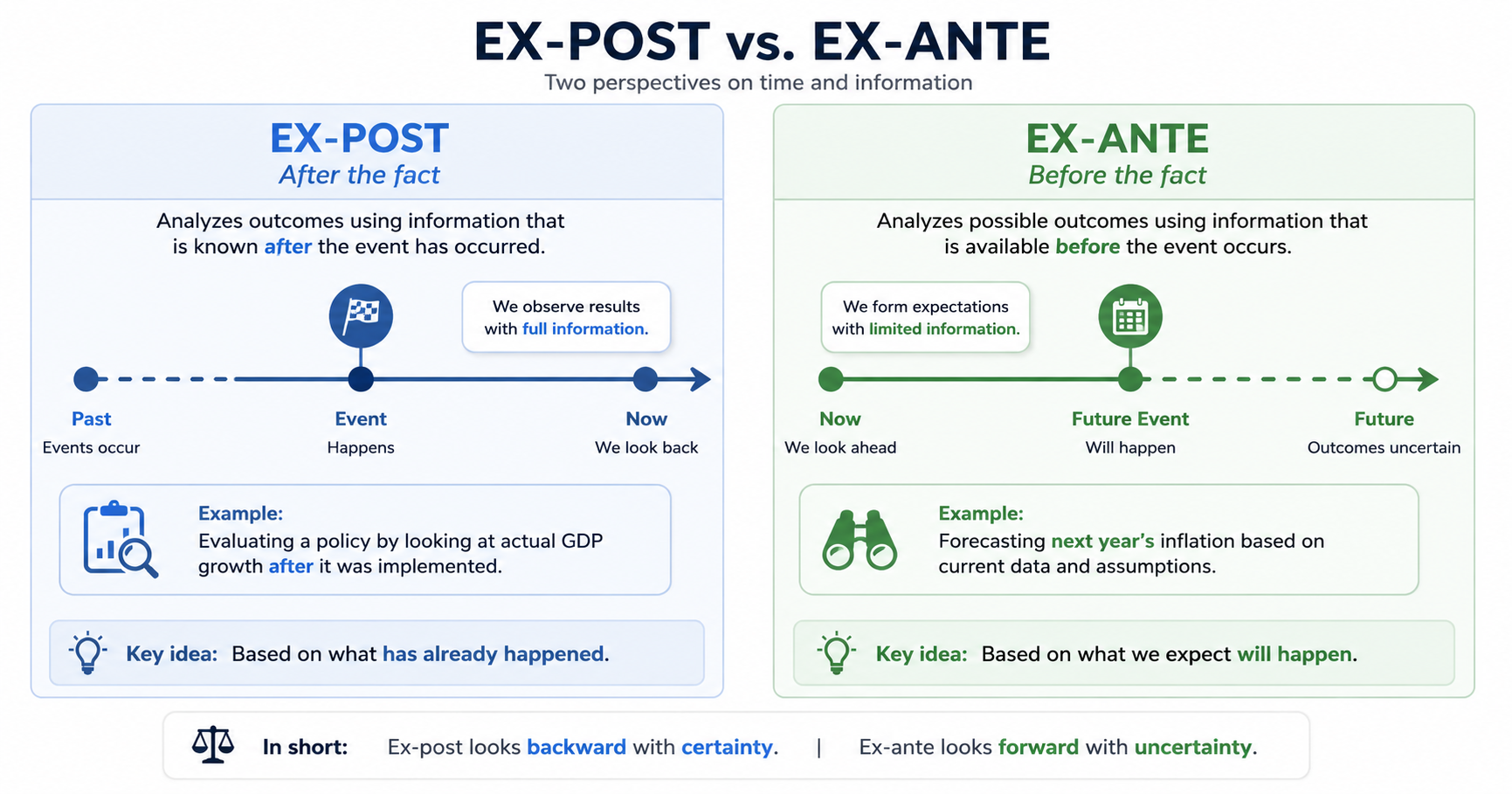
Examples of Ex-Post and Ex-Ante
Picture a game of poker. You have to place an ante prior to playing – prior to seeing your cards. Looking forward. Fold or Ante up!
Picture someone charged and detained for a crime. They have to post bail after the fact of being arrested.
Common legal contexts:
- Regulation and policy: Ex-ante regulation (e.g., licensing requirements, prior approvals, or conduct rules) tries to stop harm before it occurs.
- Contracts: Ex-ante bargaining or contract drafting — parties allocate risks and set terms before performance or any dispute arises.
- Tort law / deterrence: Law-and-economics scholars ask what rule would optimally deter accidents before they happen (e.g., setting the standard of care based on expected costs and benefits).
- Judicial review: Assessing whether a law or decision was reasonable from the perspective of the information available at the time it was made.
2. Ex-Post (“after the event”)
- Meaning: Refers to something evaluated, judged, or compensated after the event has occurred, once the actual facts and outcomes are known.
- Legal usage:
- Looking backward to assign responsibility, impose liability, or provide remedies.
- Focuses on accountability, compensation, and fairness after harm or breach.
Common Legal Contexts of Ex-Post and Ex-Ante:
- Liability and litigation: A court determines after an accident whether the defendant was negligent and must pay damages.
- Damages calculation: Courts usually award damages on an ex-post basis (what actually happened), though they sometimes use ex-ante expectations for certain losses.
- Regulatory enforcement: Fining a company after it violates rules or causes harm.
- Judicial review: Hindsight review of a decision (sometimes criticized as unfair because it ignores what was known at the time).
Key Differences
| Aspect | Ex-Ante | Ex-Post |
|---|---|---|
| Timing | Before the event | After the event |
| Primary goal | Prevention, deterrence, planning | Accountability, compensation, correction |
| Information | Based on expectations and probabilities | Based on actual realized outcomes |
| Legal approach | Rule-based, forward-looking | Fact-specific, backward-looking |
| Example in Tort | Setting the standard of care | Deciding if the defendant breached it |
| Example in Regulation | Licensing & safety standards | Fines or recalls after violation |

Practical Illustration (Tort Law)
- Ex-ante: What level of care should drivers be required to take? (We want rules that minimize total expected social costs of accidents before they occur.)
- Ex-post: Did this particular driver drive negligently in this specific accident? Should they pay damages to this victim?
Why the Distinction Matters
- Incentives: Ex-ante rules shape behavior going forward. Poor ex-ante design can lead to inefficient or unfair outcomes.
- Fairness: Judging people ex-post using information they couldn’t have known (pure hindsight) can be seen as unfair.
- Law & Economics: Much of modern legal theory debates the optimal mix of ex-ante rules vs. ex-post liability.
Summary of Ex-Ante & Ex-Post:
- Ex-ante = “before the fact” → planning, prevention, expectations.
- Ex-post = “after the fact” → judgment, liability, actual results.